

Bug Report #1: E. coli
It’s more complicated than your scary first impression

Microbes are unbelievably diverse. We haven’t even come close to counting how many species there are, but the number could be tens of millions. We best know the ones that cause disease, but these make up less than 1% of microbe species. We need other microbes to produce food like beer, bread and cheeses (everything needed for a good life), we engineer them into protein factories, they make antibiotics, they keep the soil healthy, they are used to treat waste water, they produce oxygen and so much more. We couldn’t live without them, yet most of us don’t give them much thought. Welcome to Bug Report, where each edition is an unserious guide to one of these little legends.
Today’s spotlight is on ✨ E. coli ✨
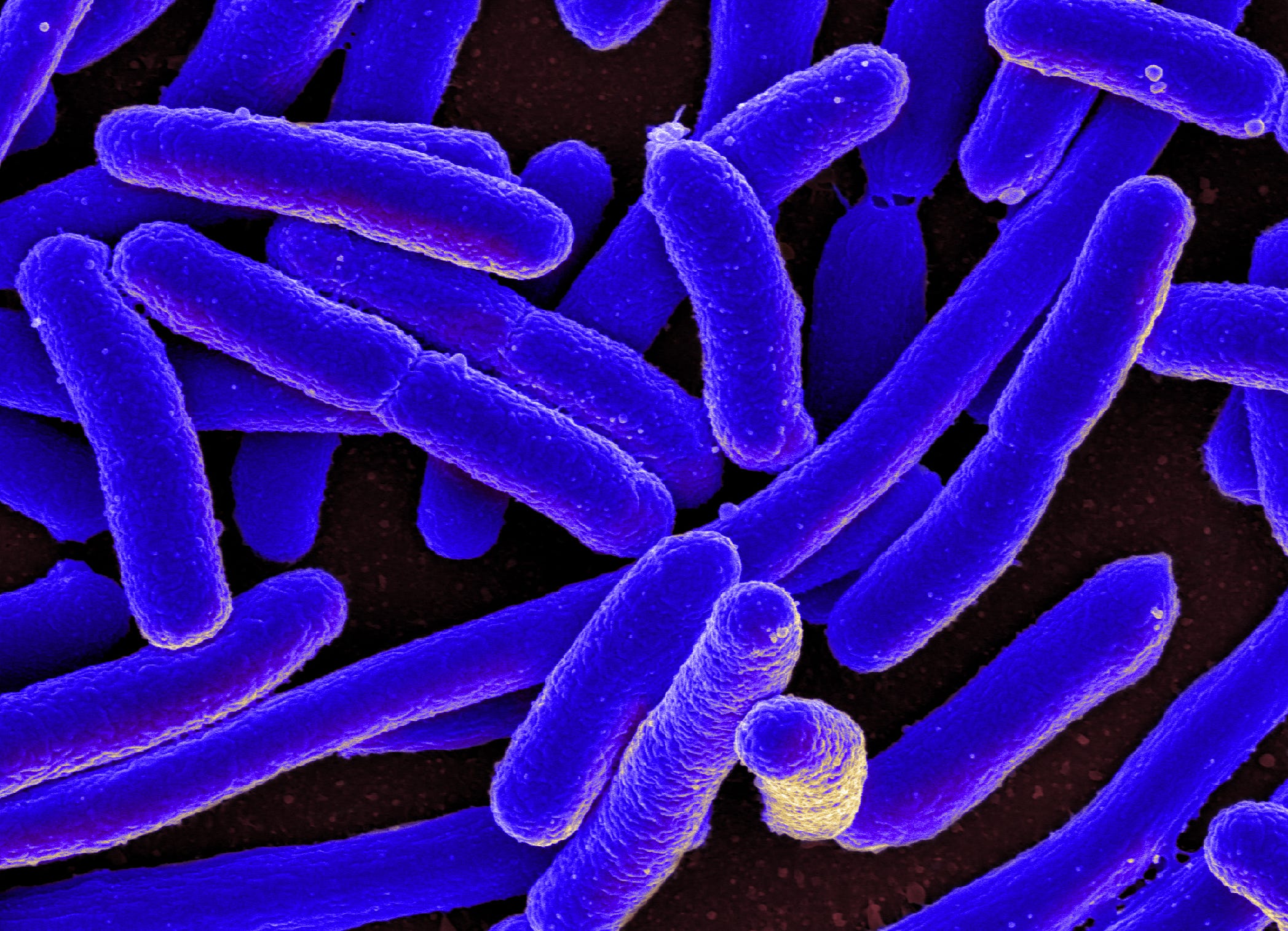
Full name: Escherichia coli
Type: Bacteria
Style: Maximalist (loves accessories)
Favourite food: 💩
Hidden talent: Growing really fast (chaotic gym bro?)
I know, I’m shamelessly jumping on celebrity hype to try and grow an audience. E. coli is about as close to famous as a bacterium can get. Most people have heard of it and definitely don’t want it anywhere near them. That’s fair enough: it is probably best known for giving people diarrhoea and this is terrible press for anyone.
Whatever you said, congratulations you’re right! E. coli really can do it all. You’ve heard of good bacteria and bad bacteria, but here’s a bug that can do both. That is because this species is incredibly diverse and strains are super different from each other — more different than humans and chimpanzees. So, in the interest of balance, would you like to hear that these bacteria have a nicer side?
A bug with incredible versatility
Most strains of E. coli don’t do you any harm at all. When we’re tiny babies, these bacteria become part of our gut microbiome (the community of different microbes that chills in our intestines). There are a few strains of E. coli that are even used as probiotics to treat people with inflammatory bowel disease. That’s how well-behaved and community-minded they are.
Further good deeds from E. coli include some evidence that it makes B complex vitamins and vitamin K2 for us in the gut. It can also be a general nice guy in the digestive system, helping us digest food.
Finally, these good strains of E. coli can take up space that stops nastier things from growing in the gut. Imagine it reserving its spot on your intestinal sun loungers with its towel, or taking up the spare seat on the bus with its giant backpack. There is no room left for someone much worse to come along, i.e. that man who sits next to you on the bus and tells you all his gross opinions.
A hardworking model and lifesaver
Ok fine, a model organism, which just means a species that is used loads in scientific research. E. coli is the lab rat of microbiology. It’s working 24/7 doubling every 20 minutes. Could you divide in half three times an hour? Didn’t think so.
It was first identified by Theodor Escherich in 1885, and the most commonly used lab strain (E. coli K-12), was cultured from a poo sample collected in 1922. Humans and E. coli go way back as colleagues. Funnily enough, we don’t know why it is called K-12 anymore; that fact has been lost to the mists of time. What we do know is that it became an absolute workhorse of microbiology, biochemistry, genetics and molecular biology, only strengthened by its genome sequencing in 1997.
It is an amazing model organism because of its fast growth, unfussy nutrient requirements compared to other bacteria (some require blood sacrifices while E. coli enjoys a simple broth), and how harmless the lab strains are to people.
Thousands and thousands of research papers have been published on E. coli and it has probably never had a day off.
One of my personal favourite experiments, because yes, I am the kind of person who has favourite E. coli experiments, is the Long-Term Evolution Experiment (LTEE). This involved taking 12 different genetically identical populations of E. coli and letting them evolve, monitoring them for genetic changes. It’s like watching the whole of history on a tiny, sped-up scale, because one generation only takes around 20 minutes.
The experiment was started by Richard Lenski in 1988 and is still running, having passed 80,000 generations. We’ve been able to see natural selection happening in real time as the bacteria got better and better at living in a flask and eating the same food every day (relatable).

Like living in a sci-fi movie
Did you know that E. coli is also a pioneer? For all the reasons it makes a good model organism, it is also a perfect tool for making proteins. This can be done by providing the DNA that codes for the protein we want on a small circular molecule (a plasmid) and zapping it in to the bacteria. Kind of like giving it a recipe for pasta carbonara and then coming back the next day to find it has made you a vat of the stuff. What I would do for a vat of pasta.
The results are called recombinant proteins and they are wildly useful. This is how insulin is made — historically we had to use insulin extract from the pancreases of animals, mainly pigs and cows, which isn’t quite the same as human insulin. Over 150 different recombinant proteins are now used worldwide to treat conditions from heart failure to asthma to cancer. It’s worth noting that E. coli isn’t the only microbe that can do this, yeast is also often used, but I think it still deserves a lot of credit.
Lots of other frankly bonkers innovations have come from genetic engineering of E. coli. Scientists have used it to make biofuels from only water, carbon dioxide and renewable electricity. Incredibly, actual computers and LCD screens have been made from E. coli. These bacteria have been engineered to perform the roles of different components of a computer and they can solve mazes!
An accessory lover

Remember when I mentioned plasmids? I know, my attention span is ruined too. These are not just lab tools, they occur naturally as rings of DNA containing extra genes. Acquiring them is one of the ways E. coli can get hold of accessory genes, giving it the tools to make different proteins and encode new functions like weapons to destroy their enemies or the ability to break down new food sources. I always think of how weird it would be if humans could do it: imagine if someone could hand you a donut and you ate it and the donut meant you now had blue hair. It’s like that.
In fact, E. coli swaps accessories with other strains so much that it can be really hard for scientists to classify which strain is which. Sharing truly is caring. Only around 20% of E. coli genes are found in all strains (this is called the ‘core genome’), and the rest is all accessories. More is more. This helps to explain why E. coli can be anything from a helpful gut microbe to a nasty pathogen.
The perfect all-rounder
If I haven’t convinced you that E. coli contains multitudes by now then you may just be a hater. There is so much more to say about it too, and I gave myself a huge challenge trying to narrow it down enough for this first edition of Bug Report. Thanks so much for reading and subscribe if you want the next edition in your inbox!
Sources
https://quadram.ac.uk/blogs/is-e-coli-always-bad-for-you-meet-the-microbe-with-good-and-bad-strains/
https://rse.org.uk/resource/the-uses-of-microbes/
https://www.nature.com/articles/nrmicro2644
https://pmc.ncbi.nlm.nih.gov/articles/PMC9487582/
https://www.acs.org/education/whatischemistry/landmarks/insulin.html
https://cordis.europa.eu/article/id/443170-breakthrough-biotechnology-enables-engineered-bacteria-to-churn-out-sustainable-biofuels
https://www.technologyreview.com/2021/11/09/1039107/e-coli-maze-solving-biocomputer/
https://www.nature.com/scitable/blog/bio2.0/computer_controlled_yeast_and_an/
Love E. Coli... During my PhD student, I hung out with it a lot. 🤣 When no one was there, I knew E. Coli would always be there for me on weekends. Hehe. Love this first article of yours. Keep writing more.
Fabulous! Thank you 🤎
Also great comment thread, you microbiologists seem like fun